
DIGITAL SELF-CONFIDENCE
Before you can work well with AI, you have to work well with yourself.
Technology is moving faster than most of us can follow. A new tool every week, a new skill we’re told we should already have. Many capable, experienced people quietly conclude that they can’t keep up, and start to doubt their own judgment. And that is where the real risk begins. When we stop trusting ourselves, we start handing over our thinking.
Not dramatically. Gradually. A draft we didn’t write. A decision we didn’t quite make. An answer we accepted because checking it would have taken longer. Each one is reasonable. However, the accumulation is not.
The risk isn’t that AI becomes too powerful. It’s that we become less practised: at judging, at doubting, at sitting with a hard question long enough to answer it ourselves. Skills atrophy when unused. Judgment is a skill.
HOW IT COMES ALL TOGETHER
The path
Digital Self-Confidence is the work that comes before the technology.
Know yourself. Understand how you think, where you’re reliable, where you’re not, and what you will not delegate.
Practise in a safe space. Experiment, play, make mistakes and face the fears that keep you at a distance, in an environment where trying something new carries no penalty.
Stand above the technology. Stop running behind it and start steering it. You decide what it’s for, where it serves you, and where it stops.
Technology should widen human freedom, not narrow it. That starts with people who trust their own minds.
Why this matters to me
In 2014 I published a paper arguing that brain–computer interfaces posed a threat to freedom of thought, and that the law should be built to widen human freedom rather than narrow it. At the time it read as speculative. It is now cited in the literature on neurorights, and the question has arrived for everyone, without any surgery required.
I have spent two decades on the boundary between people and machines. Even though I have not yet found a precise spot where a human ends and technology begins, I have observed that people limit themselves with their unspoken concerns, doubts about their own capabilities, and general tendency to avoid hard tasks. And yet the confidence they are wishing for comes only through facing themselves and the things they want to avoid. Digital Self-Confidence is the same concept, only applied in the new circumstances – the world where we hesitate about how to face the digital challenges. The only way through is by facing them, experiencing them and conquering own mind before conquering the technology.
DA VINCI AS A RENAISSANCE MAN
Why Leonardo
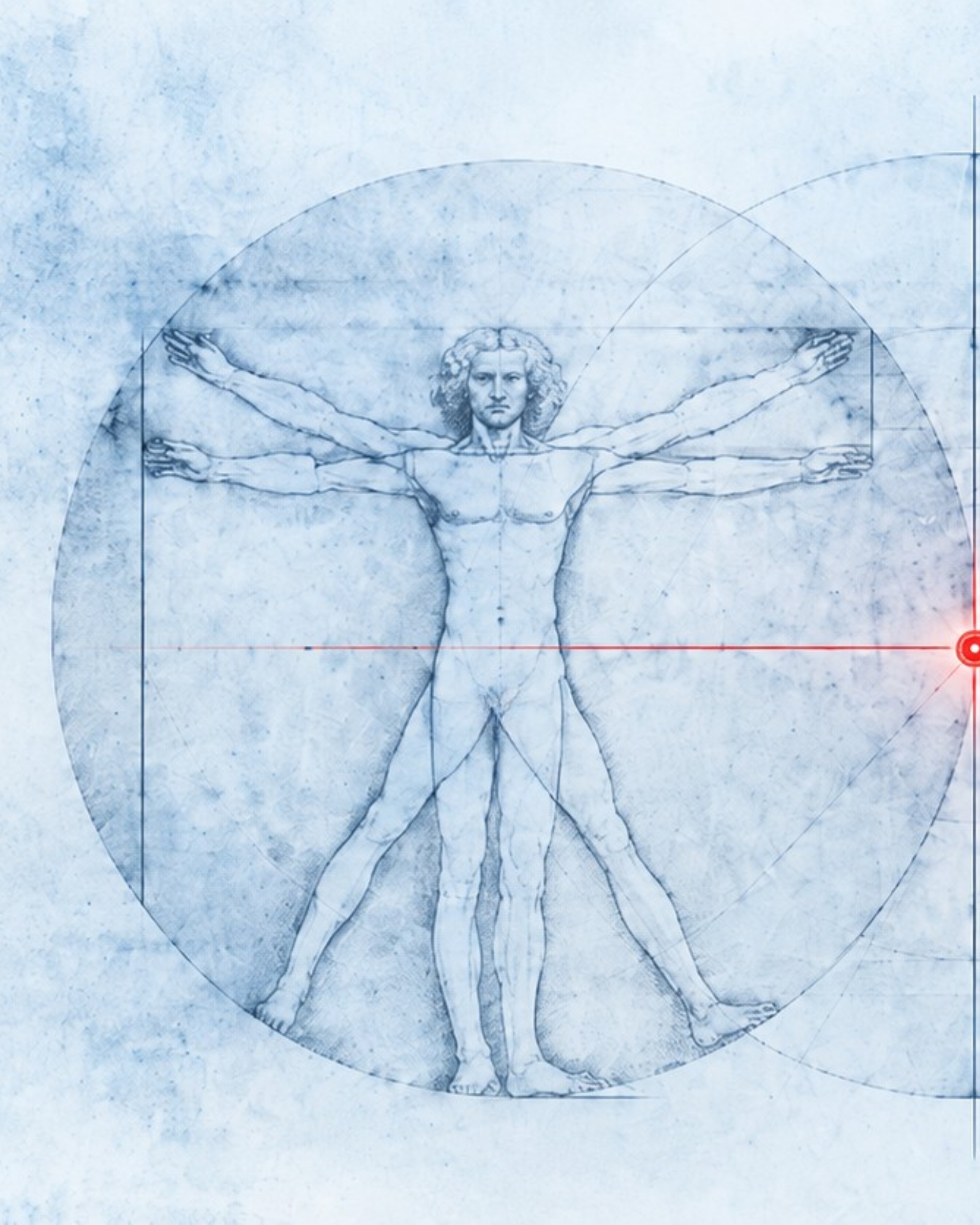
Leonardo drew a man inside a circle and a square to say that the human being is the measure.
I think that's still true. It's just harder to hold on to.
It is somehow all interconnected in my head
A question I've been asking for a long time
- 2006
- Student research prize, Masaryk University – on the legal regulation of artificial beings
- 2014
- Legal Aspects of Brain-Computer Interfaces – BCIs as a threat to freedom of thought
- 2017
- Robots with Biological Brains: Autonomy and Liability of a Semi-Artificial Life Form
- 2023
- Between the Human and the Non-Human – Ji.hlava Inspiration Forum · Beyond Human Intelligence?
- 2024
- Člověk versus umělá inteligence: Tajemství lidské nadčasovosti – keynote, Slovak Women in Tech · Humanity Redefined? – CMS, Warsaw · "Chcete poznat člověka? Dejte mu do ruky AI" – CzechCrunch
- 2025
- "To work well with AI, a person must first know how to work well with themselves" – Seznam Zprávy · international conference on AI, personalised media and personal autonomy
- 2026
- Svědomí algoritmu – Dominikánská 8 · Nuit des Idées – Institut Français
WORK IN PROGRESS
Where it goes next
Digital Self-Confidence is currently a keynote and a body of work. It has now been an ongoing work for more than two years for me. Tell me if the topic resonates with you and let's talk about where it takes us next.